
A Fan's Notes
An unavoidable detour into jazz-nerdania, on the departure of a beloved, immeasurable talent

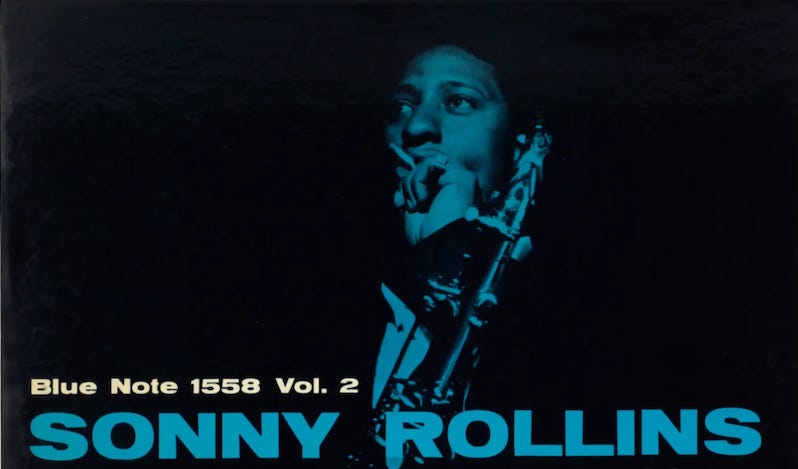
I’m not going to ruin my day writing about Sonny Rollins. He wouldn’t want that. Sonny wouldn’t want me to spend my afternoon scouring the recordings, interviews, articles, trawling for the telling passage, the illuminating aperçu, the late-period koan that puts the whole spectacular life and body of work into the galactic context he was projecting by the late 1950s.
So far I’ve even avoided reading the other pieces, though I imagine their authors also welled up with an amount of emotion that surprised them, which they chalked up to love or gratitude rather than grief, since the man lived so long, so well, and so fully, and he wasn’t an actual friend or relative, just felt like one.
I’m not going to sweat the bona-fides to speak about him either. I only saw Sonny Rollins live a total of six times, the first two as a teenager, and I’m not a musicologist or a professional musician. But I am a lifelong listener and lapsed musician who resumed practice on the same instrument last year (after a decades-long hiatus, mostly to support my son who’s starting LaGuardia High School of Music and Arts next fall on trumpet).
And because of this I can say that, after the expected punishing months of feeling and playing like a recent stroke victim—breath, embouchure, dexterity, basic instrumental proficiency all ravaged or nonexistent—when I regained enough sound and facility to meditate with favorite players, found Sonny Rollins was there, waiting for me at the threshold.
It’s not his artistry that makes you feel welcome; that’d be more of a barrier to entry than anything. It’s his buoyant, infectious presence, how fun he makes everything sound, the promise that he finds in every single melody ever sung or written. He was famous for this, that Picasso sleight of hand with the silliest, slightest line, the way he’d pull “Toot Toot Tootsie,” “Sonny Boy,” “I’m An Old Cowhand” into the jazz canon by virtue of what he played after the head.
If you transcribe certain Sonny Rollins solos, the process can make what he did on the recordings seem literally impossible, in the same way that Charlie Parker transcriptions can, revealing a compositional intention and order that’s just chilling when you slow it down and look at it—like the first statement in his “Tune-Up” solo.
As I assume the obits have made clear, Sonny Rollins was the consummate jazz improviser, not just a living bridge to Charlie Parker, Clifford Brown, Bud Powell, and the other instrumentalists who rebooted big band swing into something comparable to the modernist novel in the space of six or seven years, but his own musical universe.
He was as fleet, febrile, authoritative, and hard-swinging as anyone, but had a comic toughness that made you smile, always. (I don’t know what to call this quality, but it’s distinct with him and Thelonious Monk.) He’s among the five or six tenor saxophonists most people can recognize in any context, and one of the best for introducing newcomers to jazz.
I had a tiff with my wife last night about whether or not Sonny Rollins is a household name, and she half convinced me that, while Miles Davis, John Coltrane, and Monk are, Sonny Rollins isn’t. But I insist that his playing is as familiar and beloved as anyone’s, on any instrument.
Many people note that you can hear country music in the Texas-raised Ornette Coleman’s free jazz, but with Sonny Rollins, even when he’s playing the most vicious, straight-ahead hard bop you can absolutely hear country, soul, blues, R&B, tin-pan alley, opera, folk—seriously, American music—just in that sound alone, this warm, gruff, buzzing, laughing, yarn-spinning, spell-casting voice that could do the audiobook of a novel with hundreds of characters.
I’m trying to avoid a “gentle giant” caricature in describing his presence, but even in the mid-’90s Sonny Rollins was this destabilizing mix of extreme power and softness. He had a slightly odd speaking voice, with shades of Sammy Davis, Jr. and Kermit the Frog, and I recall his soft, gentle handshake from when another apostle and I stuck around after a show in San Francisco to get the Pope’s blessing. This apostle—a total motherf*cker on the instrument, a performance grad from North Texas State who was first-chair tenor in a top big band—told me he’d heard that Sonny Rollins played a number 2 reed, which is unbelievably soft for any pro (although he may have had a massive opening on that Berg Larsen mouthpiece). But this too tracks with a musician with his kind of unseen immensities, who pulled such long lines and thunderous cadenzas out of thin air.
When you’re learning a subject or a system, it often gets presented in dualities—Beatles/Stones, Marvel/DC, Tupac/Biggie—and, when I was growing up, the standard was Coltrane/Rollins, a yin/yang formulation helped along by Prestige Records’ marketing team, which titled Sonny Rollins’ 1956 album after its first song, “Tenor Madness,” the only recorded track to feature both saxophonists together, and, as a simple B-flat blues, a common jazz entry point for tenor saxophonists (as well as a chastening example of blues, swing, style, and rhythmic play comically undermining the raw double-time firepower).
I bring this up partially to note the surreal timeline that we’re all on, since Sonny Rollins lived to be about 250 in jazz years—Coltrane having died at 40 nearly 60 years ago—and to consider the two giants’ meaning to casual listeners now. At the time, they were probably more similar to each other than to most musicians of the era—thoughtful, spiritual, searching, and uncompromising—but today Coltrane is a symbol of obsessive exploration, known for his furious if not physically impossible solos over dense, chord-packed compositions, the famous phases in his evolution, the openly spiritual dimension of A Love Supreme. Whereas Rollins exemplifies jazz improvisation, saxophone playing.
It’s tempting to slot them into different ordering dualities—Coltrane’s Beethoven to Rollins’s Mozart, his Hamlet to Rollins’ Prospero—but you can also think of them as sounds, voices, abiding spirits. And Coltrane, who put a jet-lab-wind-tunnel of air through an extremely hard reed on an Otto Link mouthpiece with a Selmer Mark IV tenor, is Nothung, the magic sword from Wagner’s Ring Cycle, something a mortal musician stands watching in rapt amazement, afraid to get too close. (“‘Trane really f*cked a lot of players, man,” a pro jazz saxophonist told me yesterday on a phone call. They lost themselves in his wake, never regained their own direction.)
You can listen to any John Coltrane record at any time and it will always sound amazing and demand your full attention. You can live with Sonny Rollins, spend days with his music. His picture should be over the dictionary entry for sprezzatura.
And there’s this. Two weeks ago, I was in my extremely amateur version of the woodshed, my kid’s bedroom closet, and after working on tonal exercises and running through etudes and patterns, I was physically spent and found myself playing the opening phrases to the version of “God Bless the Child” on The Bridge, and within eight bars I could hear its entirety—this spare, hushed duet, prayer, lullaby that the 15-year-old me used to listen to on my Walkman at night, over and over, more to comfort myself than to learn anything. Then I checked it out on my iPhone, hearing the original recording just as I remembered it, and I swear something bloomed in my chest, opened me up—throat, head, heart. Anyone who devotes time to this kind of instrument realizes that it’s nothing but an amplifier, an analog transmitter of a human voice and soul with all its quirks.
When I got the news last week, I did that quick-take comparison to other artists of comparable significance, and briefly hit on, of all people, Philip Roth, who I definitely didn’t grow up with, and which would make Rollins, what, a cross between Roth, Muhammad Ali, Glenn Gould, and Rudolph Nureyev? But I realized that the reason Roth came up was that I’d inexplicably started bingeing on his books several months before his death, tearing through the Zuckerman novels and autumnal works like Sabbath’s Theater, Indignation, The Humbling, The Dying Animal. So when his obit appeared, I wondered if my binge had been inspired by some forgotten report on his ill health, or if the astral plane had been sending out messages of his imminent transition for the past few months.
That is, I wondered that with Roth. With Sonny Rollins, it’s just obviously true.
I realize that the above is a very narrow view of an artist as immense as Sonny Rollins—whose name, again, feels like a synecdoche for jazz and saxophone, if not Western music—and I’m sure I’ll regret not having taken in the recent discourse before committing it to digital print. But again, I think that’s what Sonny Rollins would have wanted. It’s the example that he set.
So feel free to consider this a diary entry. But if you’re on the fence about whether or not to do your own deep dive into this particular artist’s music, I’ll just add this: It is scientifically impossible to remain in a mean, selfish, life-hating mood when you listen to Sonny Rollins. And believe me, I’ve tried.
This was really beautiful and moving. I'm the furthest thing from a jazz nerd, but you've inspired me to take that deeper dive with his music.