
Escapism that isn't
Is this brutally graphic hit show about Christofascist superpowered celebrity "crime fighters" too on the nose? Or has that nose been blown clean off?

It’s a shame that so many of us have been too distracted by the stream of cartoonish malevolence, corruption, and violence in the media to enjoy the sober news analysis in a superhero show on Amazon Prime. Yes, I’m (finally) talking about “The Boys,” a show that in many ways exemplifies this newsletter’s ongoing project of crossfading certain cultural products against our terrifying American present, but that transposes its villains and events so directly from real life that it didn’t seem like there was much in the way of hermeneutics left for someone like me to do. Then two seconds’ thought about the show’s production schedule made me realize I’d gotten the whole thing backwards.
“The Boys” wasn’t riffing, but predicting, nearly two years into the future. So I want to take a moment to savor the fact that Amazon’s number-one streaming series, in its fifth and final season, is delivering its darkly satirical vision of MAGA-styled American fascism to a nation that’s largely awakening to the reality “The Boys” barely disguises in capes and lycra bodysuits.
In its most recent episode, creator Eric Kripke and his writing team signaled that the show had reached that moment in a hugely successful series where they play with formal conventions (a Tarantino-like feint at a Rashomon structure, superimposing character names before not-so-generative chapters from their POV) and indulge in pointless celebrity cameos (inside-Hollywood riffs from show co-producer Seth Rogan, Kumail Nanjiani, and others playing themselves—in a pretty bad look for all involved).
But we should take these as barrel rolls or victory laps, since Kripke and his team must have felt their work was done even before this final season wrapped, unbelievably, before the 2024 election. Since then they’ve watched as the White House, tech industry, and mainstream media hit the same major plot points and reflected the same dystopic America “The Boys” began exploring in 2020.
In case you’re a novice, the show is a big-budget, black-mirror version of the Marvel Cinematic Universe, positing a likely reality around such superpowered American celebrities that even the wised-up MCU screenwriters couldn’t really afford to address. This reality was always there, just offscreen—certainly from the moment that Ironman reimagined Tony Stark’s heroic inventor around that period’s media impressions of the tirelessly self-promoting Elon Musk, even giving him a cameo. In many ways, “The Boys” is about the real people who operate such fantasies, and the gravely damaged souls who try to embody them.
The premise is killer and elemental: What if America were in thrall to a cadre of superheroes who are just as powerful and telegenic as those in the MCU’s Avengers, only privately lacking that conventional superhero commitment to truth, justice, the American Way, or really anything but themselves? What if they were, in fact, more like the real people who tend to attain this level of corporate power and reality-TV fame: total psychopaths.
How long before people caught on? Who’d be brave enough to stop them? Who’d decide to ally with them? What if these spurious American heroes were to branch out into politics? I think you can see where this is going.
But was Eric Kripke really that prescient when he turned “The Boys” towards a more explicit political allegory in its second season in 2020? Or is American fascism really so ugly, dumb, and predictable—so cartoonish—that a showrunner can break a several credible season-spanning story arcs solely from binging on Fox News, Sinclair Lewis, Timothy Snyder, and Masha Gessen? To the point they mapped out this entire season when the whole idea of Trump 2 seemed a little bit alarmist?
This arc includes an official purge of all regime enemies as an Antifa-like imaginary terrorist cabal, ICE-like detention camps on American soil, Tucker Carlson- and Laura Loomer-like nativist influencers, presidential assasination plots, and the deranged apex predator and media phenom at the center of it all, the one-man superpower called Homelander, who comes to believe that he is God.
In an obviously career-defining role, New Zealander Antony Star plays Homelander as a square-jawed blond Adonis, his blue eyes glinting in close-up with contempt or manic need, whose features start to warp under a growing psychosis that has nuclear implications for the world. He’s joined by the clutch of terrified or ambitious fellow “supes” who round out The Seven, A-listers selected and cast by their corporate sponsor Vought, a multi-billion-dollar entertainment conglomerate (think Fox News, Disney, Pfizer, and BlackRock rolled into one) that manages their every public appearance, including carefully scripted “saves.”
The assembled supes and members of Vought’s C-suite have been vividly representing characters from Trump’s cabinet, Fox News, and right-wing influencers for the last three seasons.
In the new season’s fifth episode, for instance, the now-Homelander-directed Vought debuts new branding that depicts the blond superhero as an explicitly glowing Christ figure, since that’s exactly how Homelander has come to see himself.
This episode hit streaming two days after Donald Trump’s social media post did the exact same thing. I wonder if we owe these seemingly magical synchronicities to the fact that “The Boys” hit upon the one device that’s eluded a million SNL bits, editorial cartoons, and other attempts at Trump allegories, all of which foundered on the fact that Trump just is too preposterous to satirize, too cartoonish to caricature.
The brilliance of Homelander’s Superman-Trump chimera is that he embodies both the vain, callow, overempowered villain one third of this country sees and the smiling, paternal white savior another third of the country sees even now. Though, as in reality, Homelander’s most diehard supporters pay dearly for their faith.
In this fifth episode, “One Shots,” Homelander receives a desperate personal pledge of eternal loyalty from Firecracker (Valorie Curry), a racist, conspiracy-theorist female member of the Seven who’s been his most devoted propagandist. Standing before as she bares her soul, Homelander silently hears her out and then casually impales her skull on a metal statue (see: Kristi Noem, Pam Bondi, and every other woman Trump no longer sees as useful).
This shocking moment is just one of the ripped-from-the-headlines beats that Kripke says he and his writers saw coming in real life when they wrote the episode, two years ago. “We were like, ‘This is for sure what’s going to happen to every single person in Trump’s orbit,” he said in a recent interview. “It was the least surprising surprise ever.”
In fact, most of this season’s seemingly prophetic events came from fairly basic dorm-room speculations “about what American authoritarianism would look like,” Kripke has also said, taking chapters from other countries’ histories and “slapping red, white and blue on it.” Fascism being just that dumb, that predictable.
In the recent episode, “King of Hell,” Homelander declares dissent a sin, calls his fans “believers,” and claims Divine authority—all actions that were, again, speculative fiction when written, the episode in the can long before Trump claimed that there’s no limit on his global powers other than “My own morality. My own mind. It’s the only thing that can stop me.” So you have to admire the synchronicity if nothing else.
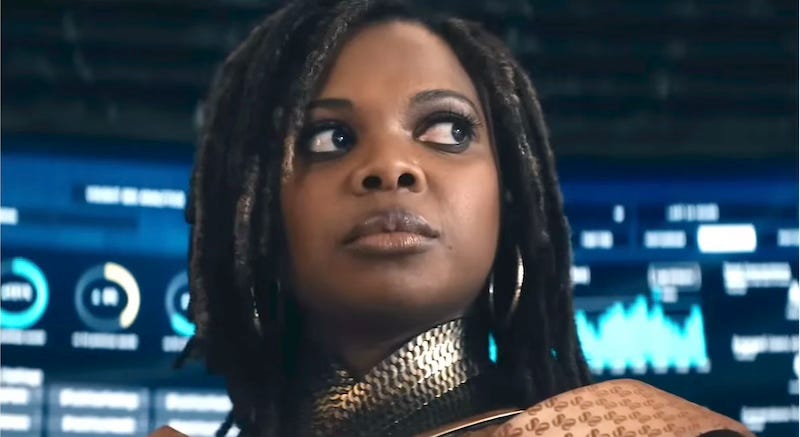
While frankly patriarchal and white-supremacist, Vought is sufficiently attentive to target demos that The Seven includes two Black characters: the supersonic runner A Train, whose arc comes the closest to actual heroism, and the relatively recent hire, Sister Sage (Susan Heyward), who may be the most interesting and troubling character in the entire show. (There’s actually a third Black character, the illiterately named Black Noir, but he’s more like Ellison’s Invisible Man, mute and barely noticed, his identity totally concealed in face and body-encasing ninja outfit.)
In addition to being Black and female, Sister Sage is also burdened with one of the least valued abilities in this looksmaxxing, dopamine-addicted echelon of marquee superheroes: intelligence. As she keeps having to remind everyone, Sister Sage is not the world’s smartest woman, but smartest person.
Since her god-like intelligence includes the emotional kind, Sage’s power exerts itself in a Machiavellian mastery of all the pieces on the board and a puppeteer’s skill in leading the various supes around by their urges and weaknesses. She also has a ruthless command of propaganda and mass psyops that Steve Bannon can only envy, arranging for Homelander supporters to be murdered in a false flag operation that vilifies the resistance, and giving Homelander enough rope to hang himself, the country, and whoever else stands in the way of her ultimate goal.
What is this goal? And who is her real-life corollary?
Sister Sage is both too smart and too emotionally regulated to be a disguised composite of Stephen Miller and J.D. Vance, though they’re good guesses.
For a while I took her to be a stand in for a showrunner, coldly directing the other characters toward a final act with maximum conflict, stakes, and spectacle. But something she says in the latest episode points to another conclusion.
If we’re to believe what Sister Sage confides to a relatively disempowered major character (the Vice President), her ultimate goal is to exit the show.
“Helping Homelander take control of the country is Phase One,” she tells the Veep. “It was only ever the beginning. Phase Two is the end.” That is, an armageddon of supes versus humans versus supes versus other humans—“Fuckin’ World War Supe,” Sage exults.
But why, the Veep asks, would she want this?
“Because I’ll be watching,” answers Sister Sage. “From my cozy bunker outside Colorado Springs.”
So is Sage a tech bro, unleashing AI on the populace as her jet sits fueled for the New Zealand compound? Or is she really the Burgess Meredith in that classic “Twilight Zone” episode—overjoyed to learn that she survived a nuclear holocaust and can, as Sage continues, “read all day, every day, with no one bothering me.”
Hey, I like reading too, but those stakes are plainly insufficient—certainly, for a galactic brain and a frequent target of racist misogyny and observer of the empowered idiocy at the very center of the collapsing evil empire that is Vought and, per longtime Trump supporter Christopher Caldwell, Trump’s America.
No, I think Sister Sage is us, the viewer: exhausted by the graphic violence and eye-popping debauchery of an extreme political satire and of the ongoing national spectacle that has made it approach greatness.
Watching this final season run down, I’ve half-wondered whether enabling “The Boys”’s run on Prime was Jeff Bezos’s attempt to atone for destroying The Washington Post—sublimating all the rage, reporting, and dire warnings of a thousand op-ed columns and exposés to one blackly satirical action series that’s now dragging us along to the bitter end.
In any case, Sister Sage now wants what the rest of us want, after a decade of watching this noisy, stupid, inferno. “Nothing,” tells the Veep, “but peace and quiet. Forever.”
Oof. I intend to watch this. My dislike of superheroes, current reality, and Prime have kept me away thus far.