
Fantasy Realism
A grim materialist takes on the gods. A direful portent for your night out.

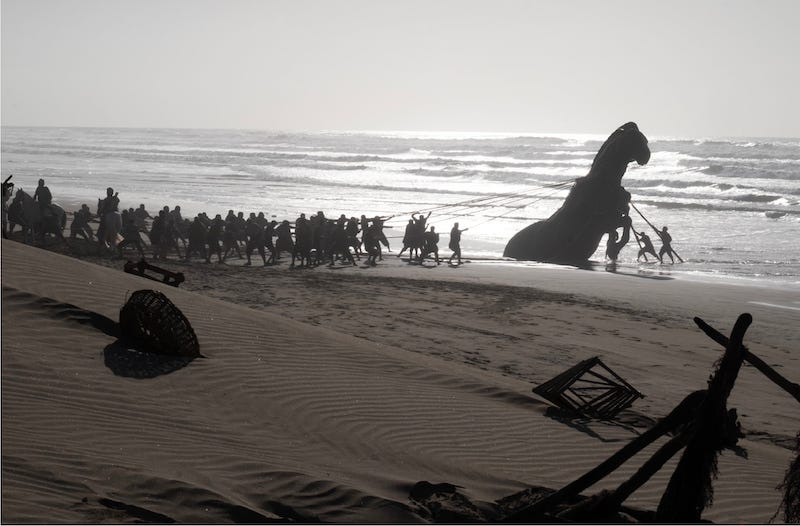
Is it possible that Christopher Nolan doesn’t like movies all that much?
Might this famous director feel that his medium’s famous affordances—epic scale, pointillist spectacle, casts of thousands—are just a tad meretricious, and rather beneath him at this point?
Has he reached a stage in his career where only the most world-historic stories are worthy of his attention, but he’s just so tasteful, such a craftsman, that he can only render their main events—like the first explosion of an atom bomb—offscreen, through allusion, abstract effects, “metaphor”?
In other words, could Christopher Nolan be full of shit?
I ask because the fam saw The Odyssey last night, at a Manhattan multiplex, and the three of us had a decent time then more or less forgot we’d seen the movie the following day. Which can’t be a good sign.
But I’m compelled to offer a response here that’s as free from received opinion as possible, having avoided the reviews and, as much as possible, the culture wars involved in Big Movie discourse—which also means resisting the urge to give full-throated praise solely to oppose the psyops being run by world’s smallest, dumbest, and most monomaniacally hateful rich man.
I should probably also disclose that I’ve read the book on which the film’s based. And that, having neither the coin nor the time for one of Manhattan’s two 70mm IMAX screens, my family opted to do that old-school thing families used to do: “go out to the movies.”
And you know what? It was fine. The film held our attention and it definitely had its laughs.
Like: whenever it dropped us into one of Charlize Theron-as-Calypso’s tantric regression therapy sessions with Jason Borne-as-Odysseus—the two lounging about in what looked like an exclusive New Age Sandals Resort, Calypso looking searchingly into Odysseus’s eyes and saying, “For some reason, you’re just not ready to go home yet.” This, after having spent the last seven years fucking his brains out and keeping him on a floral fentanyl drip. An ancient parable of libidinal self-enslavement turned into a therapy session from The Prince of Tides? Hilarious!
Or like: whenever the witty, wily, resourceful Odysseus cast his glance across the sea-wracked shoreline upon which his men are languishing and said something like: “Ten years on this fuckin’ beach.” Which reminded me of Rilke, checking out that old Apollo statue and suddenly being all like, Fuck me, I gotta change my shit up!
Or like: really any of those moments when this gravely serious $375 million film revealed its debt to Monty Python’s Holy Grail, with the motif of the stalwart hero commanding his troops “Run away! Run away!”—as they haul ass from: a) the blinded Polyphemus—sorry, “Cyclops,” say the titles, no longer a verbal sparring partner to wily Odysseus, now more like a bipedal mountain outgrowth; b) the cannibalistic giants of Laestrygon, who apparently wear full suits of armor 24-7, just hanging out, on some Mandalorian shit; and c) the shades of Hades, who are going to do what exactly if they catch up to Odysseus’s men? Spook ‘em to death?
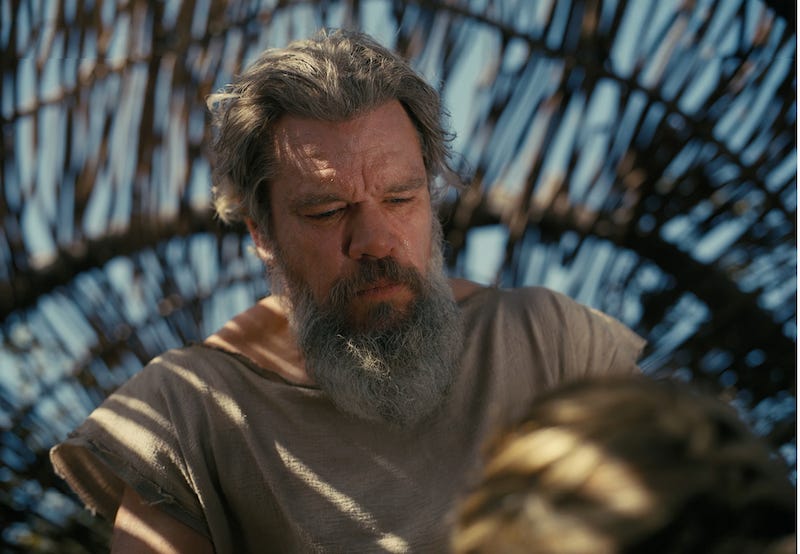
I’m sorry.
Maybe you loved this film. Many smart people seem to. The headlines and pull-quotes say The Odyssey is a consensus winner, a bold and powerful treatment of Homer’s ancient tale of war and adventure. And maybe it is. The score and sound design definitely make a compelling argument, the way that Ludwig Göransson’s electronically-processed bronze gongs, ancient flutes, lyres, and small vocal groups blend with sub-bass drones and pulses, to create a world in which the earth keeps cracking open.
But I’m trying to imagine how Nolan’s weirdly Brechtian treatment of this sword-and-sandal classic—which removes the sex, the wily machinations, the characters’ internal life, and some of the most vivid images in Western storytelling—would go over if it had a title like “The Return,” or “Aegean.”
How would people take this dark, grim, sparsely populated film, with the quasi-theatrical settings that make its 21st-century speech sort of blow away in the breeze, and its A-list actors inhabit people who seem like they’re barely there?
I’m no Great Books scholar or poet, but I am a fan of Great Books, poetry, and movies, which I kind of want them to move me. But I didn’t realize until this morning, just how unmoved I was by Nolan’s The Odyssey. And I wondered, not for the first time, whether, as a filmmaker, Nolan’s soul hasn’t been blunted, blinded, or struck mute by that Latin demigod, Ego.
I know this is unkind. It may not be Nolan’s fault. He may be a technocrat at heart, someone who fixates on the wrong things, who pulls prosaic messages from lyrical works.
I also know that it’s unfair to hold popular adaptations up to their literary source material, finding fault with the basic physics of lossy compression. But if I were on an anti-adaptation crusade, Emerald Fennell’s Wuthering Heights is right there.
That’s not what bugged me about The Odyssey, I mean, in the theater, as we watched it—enjoying the superb photography, gorgeous landscapes, sturdy direction, and the virtuoso story management for which Nolan’s justly celebrated, his ease with multiple timeframes and time paces, those temporal nesting dolls he stacks in his films.
No, what bugs you, in the moment, is something that happened long before principal photography started. And it’s something that often seems to happen whenever Nolan sits down with FinalDraft and, instead of summoning the muses, summons a prestige Hollywood screenplay.
Because, when this man sets himself to writin’? I mean, when he rolls up his sleeves to compose one of these digressive, third-act explainers that his characters intone over fiery battle montages or sweeping pans across the Aegean? When he hand-delivers the answer to whatever sixth-grader gets a homework assignment to discuss his latest film’s “theme”?
I swear, it’s enough to drive you into the arms of Uwe Boll.
I don’t think this is simply George Lucas Syndrome, which compels the sufferer to type infelicitous, jargony phrases actors can’t pronounce (although that does sound like what Anne Hathaway faced in Interstellar, saying “Love is the one thing we’re capable of perceiving that transcends dimensions of time and space.”) But that’s not what I mean here.
I’m talking about these mini-essays Nolan smuggles into his recent films, seemingly at the last minute. These voiceovers that don’t quite connect to what we all just experienced onscreen.
These moments feels less like clunky expository dialogue and more like act of subornation, like a writer-director trying to do with prose what he does with IMAX 15-perf/65mm technology: explode and elevate the story, expand its frame and its meaning.
I’m convinced you can actually feel this, amidst all the dazzling cinematography, bruising Dolby, and IMAX razzle-dazzle.
You feel it in a monologue that the disguised Odysseus delivers near the climax, supposedly to Penelope, but really to us, the viewer, in case we didn’t grok that this film is really about PTSD and moral trauma, about the collapse of Athenian enlightenment due to efforts to preserve it through violence, and, if I’m not mistaken, about the dwindling age of literacy, something Odysseus alludes to by saying—supposedly to his wife—that “our story will survive only in song because people will no longer know how to write.” Since that’s definitely something that would keep this character up at night.
Unless I’m misremembering, Odysseus actually tells Penelope, “Our age of bronze is collapsing.” And suddenly there's Nolan, sitting and chewing his pencil: Hm, how would this guy refer to the Bronze Age? I mean, if he were somehow aware that he was in an Age?
Wait…I’ve got it!
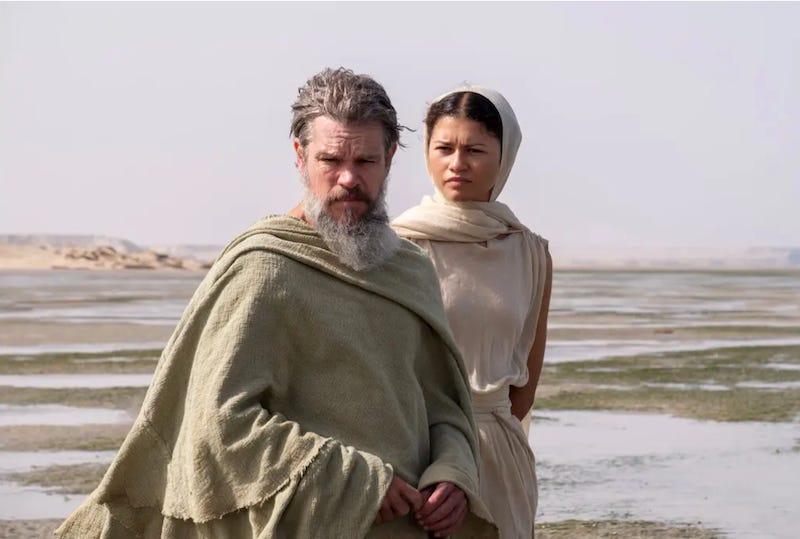
There’s no way around the fact that every modern version of The Odyssey is a meta-tragedy, an Allan Bloom-approved tale of human degeneration, casting back to a time when an entire family could spend an evening enthralled by Uncle Jeff performing a 500-line episode from the epic poem, whereas today none of us can remember his own damn phone number.
Yes, it’s a drag how dumb we are these days. Lo how the mighty have fallen. But do we really need the director of Tenet to school us on the decline of the West?
Twenty-four books, 12,110 lines of Ancient Greek, 150-400 pages in English translation, and The Odyssey still isn’t substantial enough for Nolan. He has to give us an Iliad-Odyssey mash-up: so that there’s sufficient blood, guts, trauma, shame, and healing to propel another tiresome, unexpressive man along his arc of redemption, to feature another brooding warrior-king crippled by guilt over what he’s wrought.
Maybe that’s what’s bugging me so much about this Odyssey. Not just that it’s dour, withholding, and self-important. Not just that it’s preachy about sentiments I hope everyone shares—an antipathy to endless wars, to eroding human dignity, to demonizing strangers, to mistreating veterans and dogs.
It’s the fact that when these sentiments land with a thud, which they often do, you suspect that the thud is the idea. That it’s what this film wants you, chastened, to feel.
It says something that this film’s coolest character, Samantha Morton’s Circe, feels like she’s in a different film—a deeper, sexier, scarier, more complex story about men and women, power, desire, and vengeance. And that she’s the one character who abstains from the whole heroic enterprise.
Circe doesn’t pick favorites, falling in love with this one, turning vengeful against that one. She hates them all, for their appetites and what they threaten and, like a doula, potter, or sex worker, she manhandles and massages each one to extrude his essence and reveal him as a pig. You kind of want Morton to do a mike drop there and walk off the set.
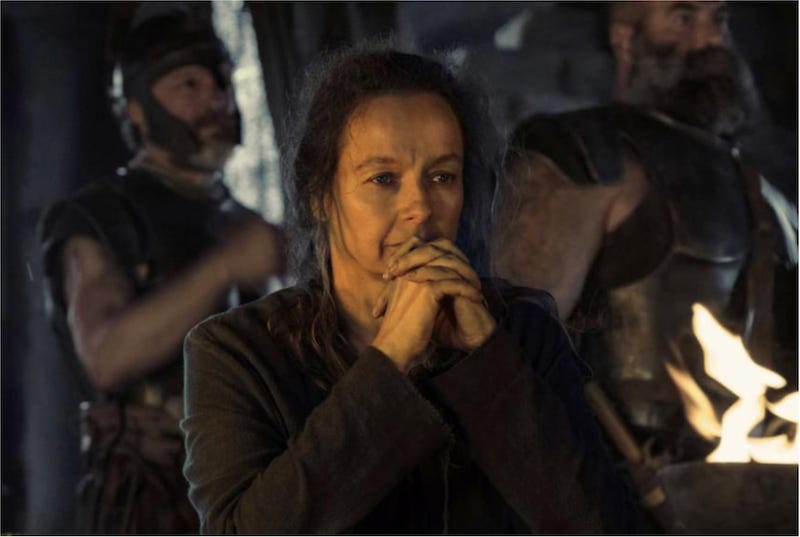
Instead, she recants her spell, and frees Odysseus’ men to resume their chosen roles as heroes, telling them “back to your disguises.” And with that, we’re back to another chapter in Nolan’s somber morality tale.
I don’t know if Nolan meant to reprise the end of Animal Farm in this scene with Circe—that moment when the animals peer into the farmhouse and can’t tell the sell-out pigs from the human farmers—but the resonance is telling. In fact, I’d love to compare the scene with Andy Serkis’s version of the same moment in his bananas-looking treatment of Orwell’s pitch-black allegory.
I’ve no idea whether or not Serkis pulls it off with his Animal Farm, but at least it looks like a novel take on an old classic. Whereas the rest of us must gird our loins and steel our hearts for whatever Great Work Nolan might undertake next.
Would we be all that surprised if it turns out to be, say, “Genesis”?
I mean, it’s got a good Nolan hero in the legendary Creator, famed architect of existence—someone who can brood and unravel under the weight of His decisions. Who can deliver those wordy monologues with a shit-ton of reverb and bass. Can’t you see it?
A black screen and close-miked voiceover: “We think we understand beginnings…” Then some yadda-yaddda about the limits of control and consequence. Then the screen opens on a gloomy, rain-slicked garden.
Then the story splits into intersecting timelines—A.D., B.C., whenever—in which a small cast develops the reluctant hero at the story’s center. A hero who’s part scientist, part warrior, part savior, burdened by betrayal, guilt, trauma, and His own importance.
I’ve no idea who they’d cast as Adam or Eve but I kind of like James Remar as the snake.
And, of course, in the best-case scenario, Nolan would voice the Big Guy himself.
Thanks for this hilarious and perceptive take. I now feel less alone after enjoying the time in the theater with this self-serious project well enough but not coming away with any real insight. Many of the episodes felt strangely under developed, coming to life only in the funny “run away” scenes. Maybe it’s lack of faith in the audience’s ability to draw their own conclusions and a desire to predigest the meaning so as to ensure the correct takeaway is received. Thus, the thud.
Same reaction. It’s amazing how little I thought about this afterwards—and how little I trusted its interpretation. Enjoyable enough, sure. But not art in any way. If it weren’t for all of the commentary, this one would just be another dusty quest film on my stack.