
Resistors
Three stories about protestors I know and love


I’m part of a small and feckless generation who were called slackers when they came of age and Trump voters when they neared retirement. I never understood these people.
I spent years as staff writer of a key Gen-X cultural organ, Spin magazine, yet I never really identified as Gen-X until about a decade and a half ago, when for the third time in a single month I heard a 20-something person say, “Well, I’m a Millennial so…”—then offer their thoughts, views, or habits around whatever topic was at hand.
Hearing this radicalized me. Triggered my sole moment of generational consciousness. Because if there’s one thing you’d never hear me or any of my coevals do, it’s to eagerly identify as members of our own group. Maybe this was a mistake.
“Ours is a spiritual war,” one Gen-X hero tells his followers in Fight Club, who apparently compensate for their lack of epochal conflict with homoerotic fisticuffs and pranks. Cut to: the bunch of misdirected, uniformed men on the streets of Minneapolis right now.
Many of our coterie joined the Boomers marching against the Iraq War and the Millennials doing the human microphone during Occupy Wall Street, blended in with younger BLM protesters, and did our part to intervene in some of our government’s more obviously immoral actions. But when MAGA smears protestors, the caricatures ignore our small coterie, dropping AI excrement on Gen-Z-coded No Kings marchers or sneering at the “elderly white hippies” protesting the National Guard in D.C.
I wonder if it’s been too easy for many of us to lay in the cut until moments like this, today, make it impossible.
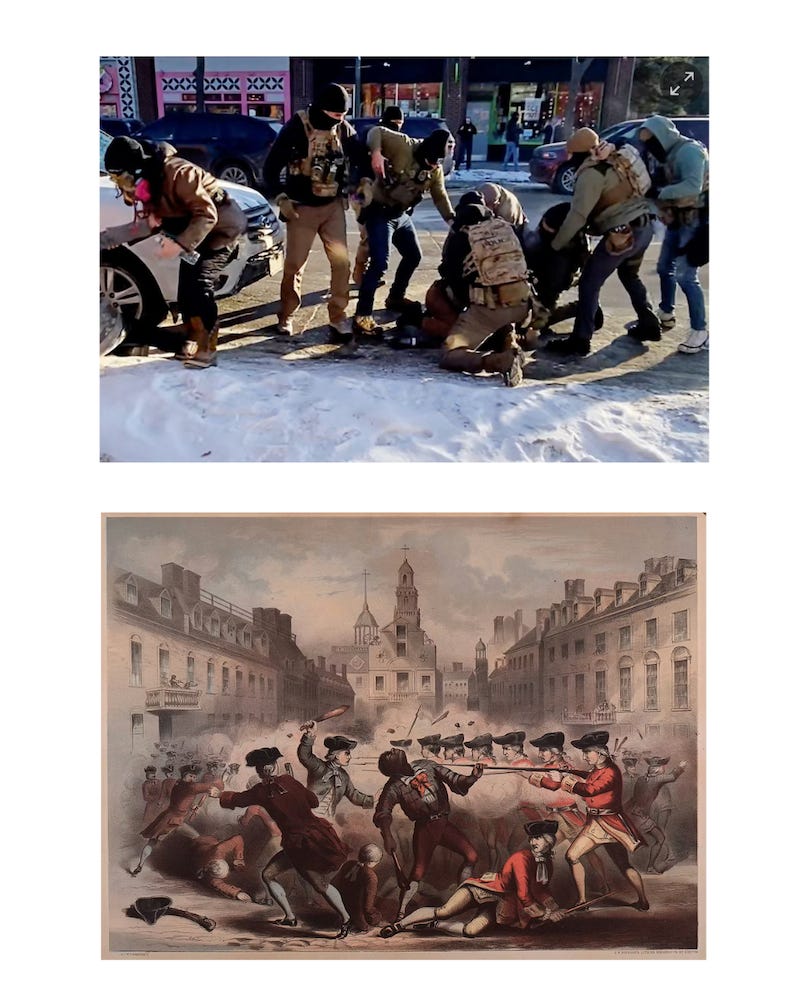
I don't know about you, but I don’t own a media company. I’m not an influencer, a political theorist, or candidate for public office. So I don’t see many options besides protecting each other — which is what the publicly executed Alex Pretti was trying to do — and changing public opinion through the kind of Civil Rights-era imagery that worked in a totally different media ecosystem.
These actions we’re talking about are loud, exhausting, and dangerous, got people like Pretti and Renee Good killed, and are ones that our government is plainly trying to escalate in order to seize more control. In plain sight, Pam Bondi just offered governor Tim Walz a chance to “bring back law and order to Minnesota” by handing over the state’s voter rolls to the DOJ so they can access blue-state voters’ personal data before the 2026 election. I sound paranoid to myself as I type this, but there it is — and most of the country has no idea this just happened.
How do you act when action feels self-destructive, and inaction is intolerable? All I’ll do here is offer some examples from my own life — which you may or may not find reassuring.
Yesterday, I brought these very questions to a longtime spiritual mentor qua literary advisor of mine who I’ve written about before in this space. He’s a NYC-born poet in his late-70s who shares my first name but whose full name, unlike mine, appears in literary reference books as, much to his amusement, “a minor Beat.” I called Chris in a bit of a state about this crisis and, in particular, how my loved ones are responding to it. And I quickly remembered that Chris brings a set of practices and principles to this kind of thing that leaves most would-be do-gooders aghast.
Chris is a practicing Buddhist of some 60 years, having begun his study shortly after running away from home as a teenager and landing at a monastery where in some kind of Shaolin Temple scenario they provided refuge and formative training. He’s now the kind of Buddhist who self-describes not as a Buddhist but as a “practitioner” and he’s been a political activist for just as long.
It feels worth mentioning that he and his early fellow activists were not cool. Cool people considered them freaks and religious extremists. Their methods of non-violence tended to things like cutting through fences to enter military installations, destroy equipment with jackhammers and air-compressors, pour blood on nuclear silos, willingly get arrested and, like several of Chris’s mentors, get epic sentences and live out their lives in Leavenworth.
Though their ranks included Catholic clergy, these people didn’t all draw on scripture of gospel music to sustain themselves. As a baby Buddhist, Chris was galvanized by one fellow practitioner whose activism is, even now, several degrees past controversial. He was the monk Thích Quang Duc who protested his government’s oppression of minorities by sitting down in a busy intersection and lighting himself ablaze. Which is where I usually tap out of conversations like this.
You’ve seen the images, either in photojournalist Malcolm Brown’s world-famous photos, the 1963 footage that YouTube flags for “self-harm or suicide content,” in numerous horror movies that reproduce it. When I look the footage, I see a horrifying, tragic act. When Chris looks at it, he sees a highly advanced practice.
To him it’s clear that Thích Quang Duc had achieved such an elevated tier of Bodhisattva consciousness that he knew impermanence in his bones, knew it in the fiber of his being. His practice was so advanced that he could surrender his corporal being at will. Such that, in the film, when the flames consume his body and it topples onto its side, you can see one charred arm reach out to right the body and complete its final practice.
We can call him crazy, a zealot, or whatever makes his act easier to live with. But I’m not aware of any mental illness that enables you to sit still in midst of a total nervous-system revolt. And for Thích Quang Duc, Chris told me, this act wasn’t activism diverging from self-care, but aligned with it, fundamentally.
We’re not meant to set ourselves on fire. Rather, we’re not all meant to set ourselves on fire. What are the rest of us meant to do?
Chris and I have a mutual friend, also named Chris, who was deeply involved in NYC’s Black Lives Matter movement.
A Millennial, this Chris was an organizer and powerful speaker, and he went into high gear the last time Minneapolis was a national flashpoint for racial justice and state tyranny, and stayed in that gear. This Chris was good at activism but like many in this movement, bad at self-care. And two weeks after we last spoke, he killed himself.
That act, I’m not ok with. The religion I was raised in condemns it as a mortal sin, and while the spiritual life I’m trying to cobble together is less definitive, it still enrages me. But I don’t think C’s death says anything at all about the causes he supported, or his willingness to put his life in service of them. I have to admit, he knew what he was doing.
One last case study comes from my own family.
Last year, my sister, a doctor, was convicted of a federal crime. This was the result of a multi-agency federal “strike force” that was announced with great fanfare to combat the opiate epidemic by targeting doctors who prescribe them. Since the days of pill mills are long gone and her region’s chief problem is actually meth, her case now looks a lot like a harbinger of quota-driven federal efforts to address illegal immigration.
Since her specialty was addiction medicine and pain management, and since she accepted patients from seven local specialists who retired at the pandemic’s peak, the number of prescriptions that were going through her office got her flagged and — 12 days after her state’s medical board had reviewed, cleared, and commended her —got her office raided by DEA, FBI, and DHS agents who hauled her away in leg irons.
Without asserting a profit motive, the government went ahead and charged her, a warrior against drug addiction, who saw uninsured patients on a sliding scale, and was a white, churchgoing 50-year-old mother of three without a parking ticket, as a drug dealer under the same statutes used to prosecute Joaquín “El Chapo” Guzmán. She faced a max sentence of 100 years.
I was there for the trial and for her sentencing and I can only say that the over-capacity courtroom full of supporters during sentencing, and the judge’s refusal to assign her any prison time, are two of many factors that might tell you that this prosecution was about something other than going after “the worst of the worst.”
Nonetheless, my sister is now a convicted felon and so, even though the medical board renewed her license, uninsurable against malpractice. Her career is over. She’s drowning in legal fees, raising three kids who need her at home, and she has federal strikes against her.
But you know what she’s doing right now? She’s on social media posting the whereabouts of ICE patrols in the region where she lives, where a new DHS operation named “Catch of the Day” is just beginning. She’s on freezing corners in maligned neighborhoods, doing outreach, preserving lives, legally observing, and obstructing “justice.”
My sis is now on her third probation officer. She has to log on every so often to say, yes, she still lives at this address, no, she doesn’t have a firearm, no, she wasn’t arrested again. She asked her first PO if she was allowed to attend activist events. The PO said that she could, technically, but we know how much protection legal technicalities is these days.
This is someone who sat in a courtroom as her name was read aloud in the phrase “…vs. the United States,” who listened as her text messages were publicly misrepresented, mischaracterized, and occasionally misread, who knows the reality of government surveillance and overreach.
And with every detailed post she makes about ICE movements and activities, I have to fight the urge to call and light her up about indulging in this kind of cringy virtue-signaling when she and her family are so vulnerable, when she could easily get violated and sent to prison.
But as my older friend Chris reminded me, she knows what she’s doing.
More than most pundits, critics, and analysts I follow, people like her seem to understand that our government has already gone well past the kind of unthinkable behavior that should get you out of your homes, that should force you to engage. Not necessarily to the point of our own destruction, but certainly well past the point of our comfort, deadlines, and security.
The only thing that seemed obvious after the 2024 election was that we were on our own. Not everyone should light themselves on fire. But right now, staying cool feels like a death sentence.