
Smooth Operator
In "Relay," a dead-cool Muslim New Yorker beats the Patriot Act's surveillance state.

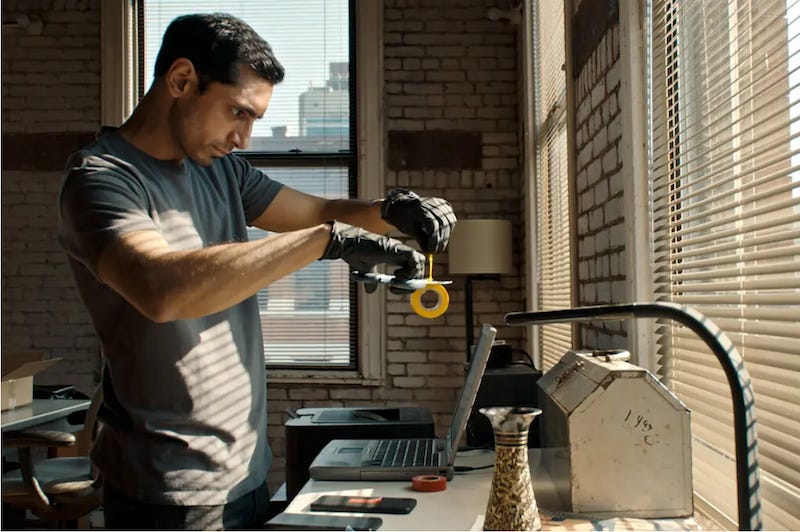
When I was growing up, one of the meanest things you could do to someone was hang up on them. I’m not suggesting some lost age of civility here, just recalling how violent this particular act could feel. In the era of home-anchored landlines, this was an abrupt, unilateral destruction of palpably shared audio space. The sudden glare of the North American dial tone, its detuned major-third droning like a flatlined pulse on an EKG. Oof: a hang-up dropped you into a noir film whose femme fatale slapped you in the face. So if like me you’re a connoisseur of either retro passive aggression or the paranoid thrillers of the 1970s, I want to refer you to the slept-on 2025 film, Relay, which stars the riveting Riz Ahmed as a state-less agent whose ingenious use of the titular phone service enables a brutal new kind of telephonic flex — one that brings confrontations with power into a new register and suggests that even today’s surveillance state might be evaded if you just step out of the ableist world.
Ash is a lone-wolf operative in the mold of Gene Hackman’s Harry Caul in The Conversation, a highly adept fixer who works as intermediary between corrupt corporations and their whistle blowers, many of whom have been terrorized into surrendering evidence that they’d hoped would bring down the wrongdoers. In this way, it’s a post-everything story with downsized expectations for all involved.
For Relay, director David Mackenzie (of 2013’s killer prison drama Starred Up) and screenwriter Justin Piasecki transpose the look and vibe of ’70s conspiracy thrillers into a neoliberal world of corporate brutality. You can tell that they shot it in New York City and gave it a chilly HD edge, which makes it thematically and visually similar to Michael Clayton, Margin Call, and other entires in the “halogencore” genre that critic Max Read coined and describes thusly:
Halogencore movies are stories of corporate intrigue and malfeasance, told from the point of view of characters on the “outside of the inside” — low-level apparatchiks, functionaries, subordinates, and middle managers, navigating crises from the periphery of real power. …They are not stories of lasting change, stunning revelation, or dramatic reversals of fortune. They are stories of beaten-down people acquiescing to or negotiating compromise with power.
Per Read, these newer films differ from ’70s paranoid thrillers, in which journalists or detectives uncover corruption and conspiracy, while in halogencore “well-to-do professionals learn to ignore it.”
Relay diverges from both models is in Ash’s mission, which is to protect those professionals who couldn’t “ignore it,” but who realize they’re unwilling to self-immolate for accountability. They’re chastened would-be crusaders who just want to submit and be left alone. (See: the Democratic centrist voter.)
But since even submission puts his clients at risk, Ash provides the clandestine and lucrative service of brokering all interactions between them and their former employers. And to protect his own anonymity, he communicates exclusively through Tri-State Relay (TSR), a fictional version of a real-life service that enables sight-, speech-, or hearing-disabled people to communicate via a TTY (teletypewriter) machine and a live human operator. Which is where Ash’s telephonic power moves come into play.
When Ash uses a TTY to negotiate with a crew of dangerous, tech-savvy opponents, these guys are still conferring over his demand and formulating a response when a human operator gently informs them, “Your caller has hung up.” Damn.
One thing meaner than hanging up on someone? Leaving it to someone else to tell them you hung up.
Even people who haven’t read every John LeCarre novel should recognize the surpassing dopeness of this outside-the-box bit of tradecraft. Using analog comms and the Americans with Disabilities Act, Ash manages to establish secure communication in our post-Patriot Act age of total surveillance. And in these secure conversations, Ahmed is magnetic in his silence, speedily typing on a TTY device, his instructions, warnings, or threats taking on a chilly and impenetrable sheen as read aloud by a third party, like a medium channeling a ghost.
Lily James plays Sarah, who we meet as a scientist who was fired, then stalked and harassed, by a biotech company after she raised concerns about a harmful product. An intermediary refers her case to Ash, who we’ve thus far observed only from a distance, a could-be extra in opening street scenes, a Travis Bickle-like loner in a spare Manhattan apartment. Ash’s first conversation with Sarah begins with a clinical-sounding human operator explaining “The person who’s called you is likely to be deaf or hard of hearing. The caller will type their conversation and I’ll read it to you. When it’s your turn to speak, I’ll type everything you say to them.” At this point, it’s not even clear if Ash could speak with her if he wanted to.
Through a series of restrained observational scenes, we learn that Ash is a Muslim raised in the shadow of 9/11 and, perhaps consequentially, a recovering alcoholic. This goes about a third of the way toward explaining a guy with his kind of Jason Bourne-like street moves, and it doesn’t remotely explain the belief-taxing counterstrike that consumes the (silly but satisfyingly kinetic and even Hitchcockian) third act.
All this said, at this moment in American history, when the federal government is spying on Reddit users who monitor their overreach, and Super Bowl ads sell Orwellian telescreens to pet owners, watching Ash’s David trouble the Goliath of tech-powered global capitalism goes down way too smoothly for me to quibble.
Ash’s attenuated exchanges with his opposing ops brought to mind another cinematic study of the strategic pauses and non-responses in cutthroat negotiations, Tomas Lindholm’s 2012 thriller A Hijacking. A quieter, chillier Danish analogue to the nautical thriller Captain Phillips, it follows cool-as-ice shipping execs whose negotiation skills are no match for Somali pirates who seize one of their ships and hold its crew for ransom. In a series of excruciatingly tense long-distance phone calls, intermediaries like the pirates’ translator emerge as power centers, relaying their Somali demands to the English-speaking Danes and making constant editorial decisions about what to alter, revealing the more absent interlocutor as the dominant one.
If unknowability is power, Ash commands it, largely through his remoteness, which Ahmed makes compelling, his eyes constantly in motion as he formulates plans and monitors his client. For the film’s first 15 minutes, we not only have little idea who Ash is or what he’s doing, but also whether or not he’s actually deaf (a suspicion helped along by his previous leading role in The Sound of Metal). In this way, Relay manages two coups in one.
The first is the title communication mode.
Not only does it enable Ash to remain untraceable, it also launders his requests, instructions, and demands through the voice and affect of another human being. It transposes gutter negotiations like ransom and extortion into the genial, service-oriented, pleasantly neutral (and mostly white and middle-class-coded) tones of Tri-State Relay’s human operators. Their sunny professionalism further infuriates the corporate goons, whose suppressed violence builds in the pressure of customer-service bonhomie.
The second coup is casting.
If you were looking for the one human phenotype likeliest to be able to move throughout New York City’s streets and subways ignored and unnoticed while also being utterly magnetic to the viewer, you’d stop looking the second you found Riz Ahmed. The 43-year-old British rapper and classically trained actor is about to premiere an Amazon Prime showbiz satire, Bait, whose premise is that he’s being considered as the new James Bond. Hardly a stretch for someone who looks so freaking cool just crossing a street.
At the point, the nickname “Riz” is way too on the nose. Ahmed’s huge watchful eyes, angular face, and wiry frame make him so compulsively watchable that we’re just fine observing him move wordlessly throughout this city — doing an espionage quick-change here, visiting a warehouse safe-room there — even when we don’t have any idea who he is or what he’s doing, without even hearing him utter a word.
While we don’t ever really learn who Ash is, what he does stays with us. He inserts himself between power and those who threaten it, however briefly. He’s a bulwark against the attenuated evil of men who take free flights on the Lolita Express as standard perks. As a figure, he’s less a knight errant in the Equalizer/Jack Reacher vein and more like Robert De Niro’s guerrilla plumber in Terry Gilliam’s Brazil. A hyper-competent rogue technician, a freelancer in an unfree society. Someone who the powerful call a terrorist because he makes it harder to crush opposition. Ok, I’ll say it, the man is Batman, only with dead-drops, vinyl records, and mastery of the U.S. Postal Service. Instead of gizmos, a butler, or belief in there being such a thing as “crime.”
In the opening scene, a harried midlevel corporate schlub walks through New York streets at night, bearing visible signs of a recent beating and carrying a satchel. He enters a Lower East Side diner and takes a booth where he’s soon joined by an elegant white-haired man in a $10K suit who looks like he just stepped out of an interview with CNBC’s Squawk Box.
“I look at you and you seem almost normal,” the schlub says to the CEO. “I thought I’d get to see what evil really looked like.” He sighs. “But you just look like everyone else.”
The schlub hands over the evidence and takes a selfie with the CEO, who gives a tight, fake grin, grabs the folder, and heads outside to a waiting car. As the ex-whistleblower leaves the diner, a man at another booth — youngish, brownish, probably a laborer, wearing a hoodie , hi-res vest, carrying a hardhat — gets up and heads out into the chilly, aqua-tinted night.
If he wasn’t played by Riz Ahmed you might not even notice that he’s there. But he follows the broken would-be whistleblower through the city streets at a tactical distance, shepherding him to Grand Central, onto a Metro North train, and on to safety in way I wish he could shepherd the rest of us.