
Ye or Nay?
Parsing one of the worst-timed public apologies in modern memory

There isn’t a lot of levity in periods of national trauma like this one, but a recent news item reminded me of one such a funny moment from the immediate wake of 9/11. It was just after the banner headlines, amidst the litany of victims and ominous rumblings from the State Department, when a bulletin arrived straight from Limp Bizkit Central Command to inform us that rap-rock frontman Fred Durst was officially quashing all his beefs. All the feuds and shit-talking he’d been up to with people like Christina Aguilera and the members of Creed? He was done with all that shit. Thank you for your attention to this matter.
This was just the kind of surreal, unintended comic relief you might have felt on Monday when, two days after federal agents had murderously escalated the regime’s 9/11 on American citizens, the artist known as Ye ran a full-page ad in The Wall Street Journal offering a blanket apology “To Those I’ve Hurt.” And a nation learned to laugh again, however briefly. Or at least I did.
In case your attention was elsewhere, the hip-hop icon formerly known as Kanye West — once one of the most influential artists of his generation, lately a walking entry in both the DSM-V and the ADL watchlist — recently attributed his roughly eight-year, two-album run of tweets, official statements, public associations, videos, and songs proclaiming fascist and pro-Nazi sentiments to an extended manic phase.
I won’t try to list every product of this amazingly prolific manic phase — from the Paris Fashion Week debut of his Yeezy line of “White Lives Matter” T-shirts to the 2025 song “Heil Hitler”— I’ll just note that even when it was just kicking off in 2022, this phase impressed the Republican House Judiciary Committee enough to inspire the campaign slogan posted on X: “Kanye. Elon. Trump.”
All of which makes his pulling the mental illness card now simultaneously credible, a serious category error, and a stark mirror to our national psyche.
What insights I can offer into Ye’s brain come from having spent significant time with the person we might call the Good Kanye for an article published one year after his 2004 debut College Dropout had made him a cultural superstar and one of Time magazine’s most influential people in the world.
During my days-long immersion in West world — in the bowels of Giants Stadium during Summer Jam with him and Jay-Z, at a gala at Tiffany’s for his album, various vehicles to hither and yon — the 27-year-old struck me as that ascendent archetype of the period’s cultural landscape, the professor’s kid (see Dave Chapelle, Tom Morello, Zach De La Rocha, many others).
West was bright, quick, self-effacing, comfortable in elite circles and arty spaces, with the kind of unwavering self-confidence The New Yorker’s John Lahr also observed in nine-year-old Zohran Mamdani, when he reported a 2002 profile of his mom, filmmaker Mira Nair, whose son “exud[ed] the charm of the well-loved.”
West, a singleton whose Ethiopian name means “the only one,” had this charm quite early in life. His mom, Donda West, told me that even his kindergarten teacher told her, “Well, he certainly doesn’t have any problem with self-esteem, does he?” (She also reported that Kanye had gotten her “hooked on Ebonics,” which I found cute as hell back then. Still do.)
Twitter psychoanalysts point to Donda’s death in 2007 as the tragedy that sent Kanye over the edge, citing the subsequent MTV Music Awards show where he bum-rushed a 19-year-old Taylor Swift for not being Beyoncé. His next album, My Beautiful Dark Twisted Fantasy, offers another data point, with lyrics describing sexual compulsions and other addictive behavior from the slight remove of a memoirist still high when he’s writing.
But the proto-Trumpian award tantrums date back earlier, as do the whole host of stunts, statements, and behaviors that inform commentator Keith Boykin’s assessment in a 2022 Washington Post piece: “This is the thing about Kanye, he wants all this attention.” Which may be the most ominous observation you can make about someone seeking power today.
Somewhere between the absorption into the Kardashian Borg, the Neverland Ranches out in Wyoming, the channel-surfing, global-artist ambition of albums like Life of Pablo, West’s warping persona and diffusing music began running on parallel tracks, while the turnover rate of hip-hop-based music — bounce, trap, drill — made it harder to assert the central role he seemed to need. So that today his cultural imprint is mostly subliminal, while his media presence — “Kanye. Elon. Trump.” — is debased meme currency.
In other words, if you charted West’s slow-then-fast descent into pathology across time, its curve would look a lot like that of the American brand: from the pre-diagnosis period of the Bush-Obama years (after the death of West’s mother), to the turning point of 2016 (when he was hospitalized for “exhaustion”), to the acceleration in 2018 (when he publicly admitted that he was bipolar and off meds), to the period of florid antisemitism, Hitler praise, and presidential candidacy that ran from 2020 to present day.
What if Yeezus is us?
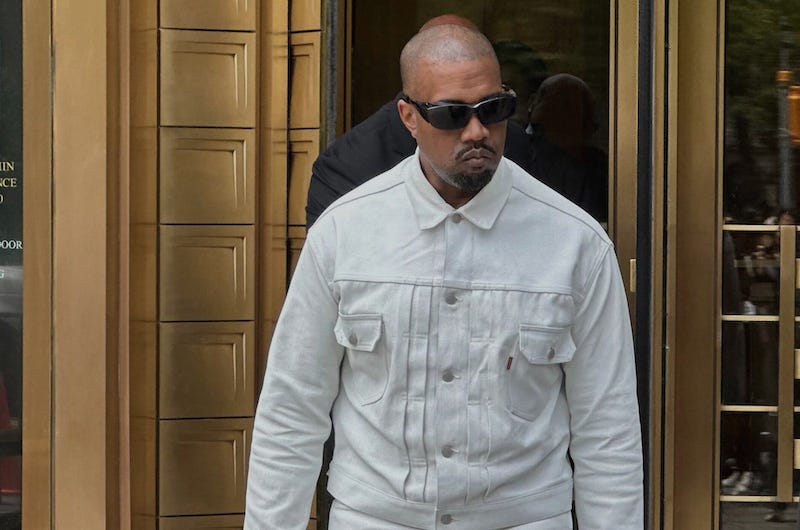
The WaPo piece about Ye’s apology ran a telling photo of a stricken- but surprisingly fit-looking Ye — without the hamster cheeks or glittery eyes — leaving the courthouse where another errant hip-hop giant, Diddy, was presumably having a pretty rough go of things.
There are a thousand crucial differences between these two men, the two foremost in my mind being Ye’s lack of a criminal conspiracy for sexual assault and Diddy’s lack of artistic talent. But there’s something grandiose in a way that feels characteristic of both these rap icons in the epic diagnostic retcon West is attempting with this Wall Street Journal ad, which implies that his slate should actually be cleared back to 2002.
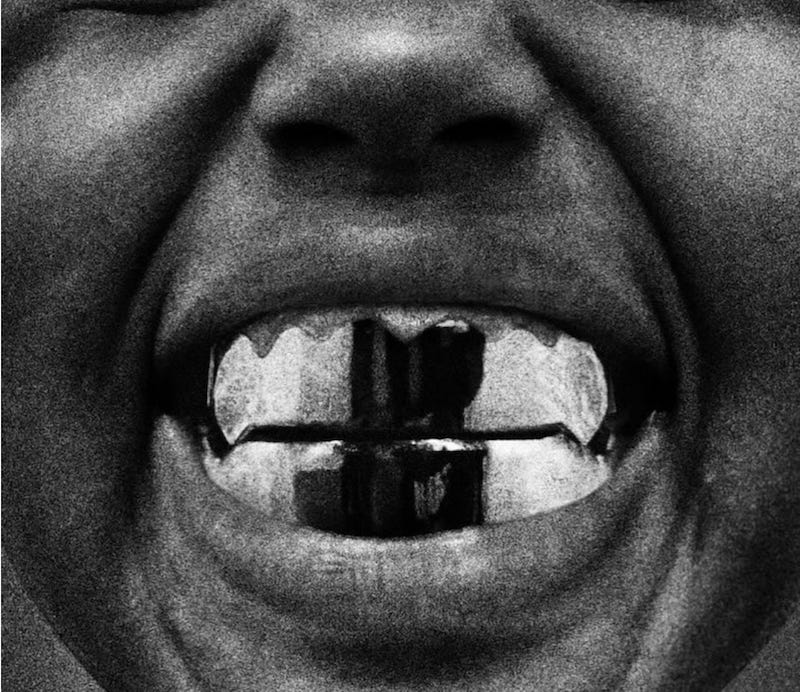
That’s the date of the car accident that shattered West’s jaw — providing the drama of his debut single “Through the Wire,” rapped through a wired jaw — and which West says also caused an undiagnosed “injury to the right frontal lobe of my brain,” to which, along with bipolar disorder, he attributes all subsequent “impulsive” behavior. Therefore: “I am not a Nazi or antisemite. I love Jewish people.”
Apparently, the entire pro-MAGA period, with all the hate speech, antisemitic obsessions, and canoodling with Nick Fuentes, are symptoms of bipolar type-1, whose most difficult aspects are, per West, “the disconnect moments — many of which I still cannot recall — that lead to poor judgment and reckless behavior that oftentimes feels like an out-of-body experience,” he wrote. “I regret and am deeply mortified by my actions in that state, and am committed to accountability, treatment, and meaningful change.”
One thing this document does is cast significant doubt on the diagnostic skills of Dr. Ye West.
This is a man who, in 2023, released a text to Elon Musk stating “I’m not bipolar. I have signs of autism from my car accident.” And who last year told a podcaster that his bipolar diagnosis was incorrect and that he actually had autism (in his case, automobile- rather than vaccine-induced).
Another thing this document does is wave that red flag in any apology, a choice of explanations. Bipolar disorder, brain trauma, autism — I didn’t do it, I didn’t mean to do it, if I did it I’m sorry, and I won’t do it again. And its form is the kind of general group-text apology you’re more less expected to delete on receipt.
But all this is complicated by the fact that West has indeed been observably mentally ill for years.
Where your average tabloid or social-media snapshot of an errant celeb shows them driving poorly or wearing an unbecoming facial expression, the ones of Ye were like en plein air mugshots: a bloated, glassy-eyed man who hasn’t slept in months. Not. Well.
On his recovery-oriented “Don’t Die” podcast, Hollywood addiction counselor Bob Forrest talked about seeing Ye at a valet stand somewhere in LA and concluding that the only recognizable difference between him and some off-meds unhoused guy on Third Street was two billion dollars.
Might this person have been sane-washed by a platform like today’s X, where the craziest, vilest statements barely rate notice? Did the same deeply unwell person behind so many weaponizable political soundbites see the opening scenes of the 50 Cent-produced Diddy documentary in which Diddy cusses out his lawyers for their bad p.r. strategy, and decide to get ahead of things himself with a better team?
Or should hope-starved liberals look to Ye as they seem to doing Marjorie Taylor Green, in whose MAGA apostasy they see, if not enlightenment, the instincts of a cunning rat on a sinking ship?
As the aforelinked WaPo piece noted in 2022, Ye has been “a defining character in the digital age’s attention economy.” Indeed, he’s “his own weather system, which follows a fairly predictable cycle: He basks in the culture’s adoration, then loses it by saying or doing something outrageous or downright offensive, then digs his heels in and makes things worse while fans attempt to excuse his behavior.” Who does this sound like?
I don’t think it’s overstating things to note that this apt assessment came midway through the Biden administration, and that the weather cycle it describes is the same one that surrounds another petulant, award-grubbing, nazi-embracing adult infant with a bottomless need for attention and praise, who’s on the verge of invading Greenland. Which means it’s possible to wish Ye well with his recovery and to recognize that he couldn’t have picked a worse time for this kind of apology.
Ye is apologizing to a nation that’s deep in the cycle of domestic abuse — desperate for relief, too willing to believe apologies or deescalations, hanging our hopes on slim reeds like a moral reckoning in the GOP or a “drawdown” in Minneapolis — this last a reed that broke the second we got to the part of the sentence that had “Tom Homan” in it.
As Douglas Rushkoff recently observed, “Another way of imposing authoritarianism is to give victims false victories. Try outrageous things and then pull back. Like shoot some citizens, then withdraw a bit and replace the guy in charge. …Show the victim you can kill them, and then ‘reward’ them with mere abuse. When the oppressor ‘backs down,’ it’s strategic. It means we’ve already become ready to accept their terms — which can change any time.”
Four years ago, the political commentator Keith Boykin marveled at the delayed reaction to West’s pathology, musing in WaPo, “Where have they been? I don’t understand why it took people so long to get to this place.”
Maybe they were living in the past. Maybe they were remembering the West who stood on live TV during a telethon for Hurricane Katrina victims and blurted out: “George Bush doesn’t care about Black people.” Which made many take him for a contemporary Civil Rights hero with killer style.
But as that same WaPo piece points out — in case all the tweets, soundbites, and streaming songs didn’t make it clear enough — West was never anyone’s liberal hero. He never aligned with any political party, movement, or cause. “Ye’s primary allegiance was always to himself,” the piece concludes.
And in the end, that makes Ye just like the execs, ideologues, white-supremacists, grifters, and psychopaths who seized the moral, legal, and attentional vacuum at the center of this regime to advance their own interests. The people who, in so doing, have drawn a stark, non-negotiable line between themselves and the rest of the country.
And when such people issue a blanket apology — couched in psychiatric, religious, or recovery terms — we must give them the same response we now give brother Ye.
That’s fine, dude, it’s all good. Now take your meds and leave us alone.
Brilliant framing of the apology as a mirror to the larger abuse cycle. The comparison to Fred Durst's post-9/11 peace treaty is perfect for showing how celebrity self-importance collapses context. I've noticed this pattern where public apologies get timed to newscycles in ways that accidentally reveal their true function as brand management. The diagnostic retcon going back to 2002 is the kind of detail that shows someone workshopped this with lawyers not therapists.